
Why Wrong Business Info Shows Up on So Many Sites at Once
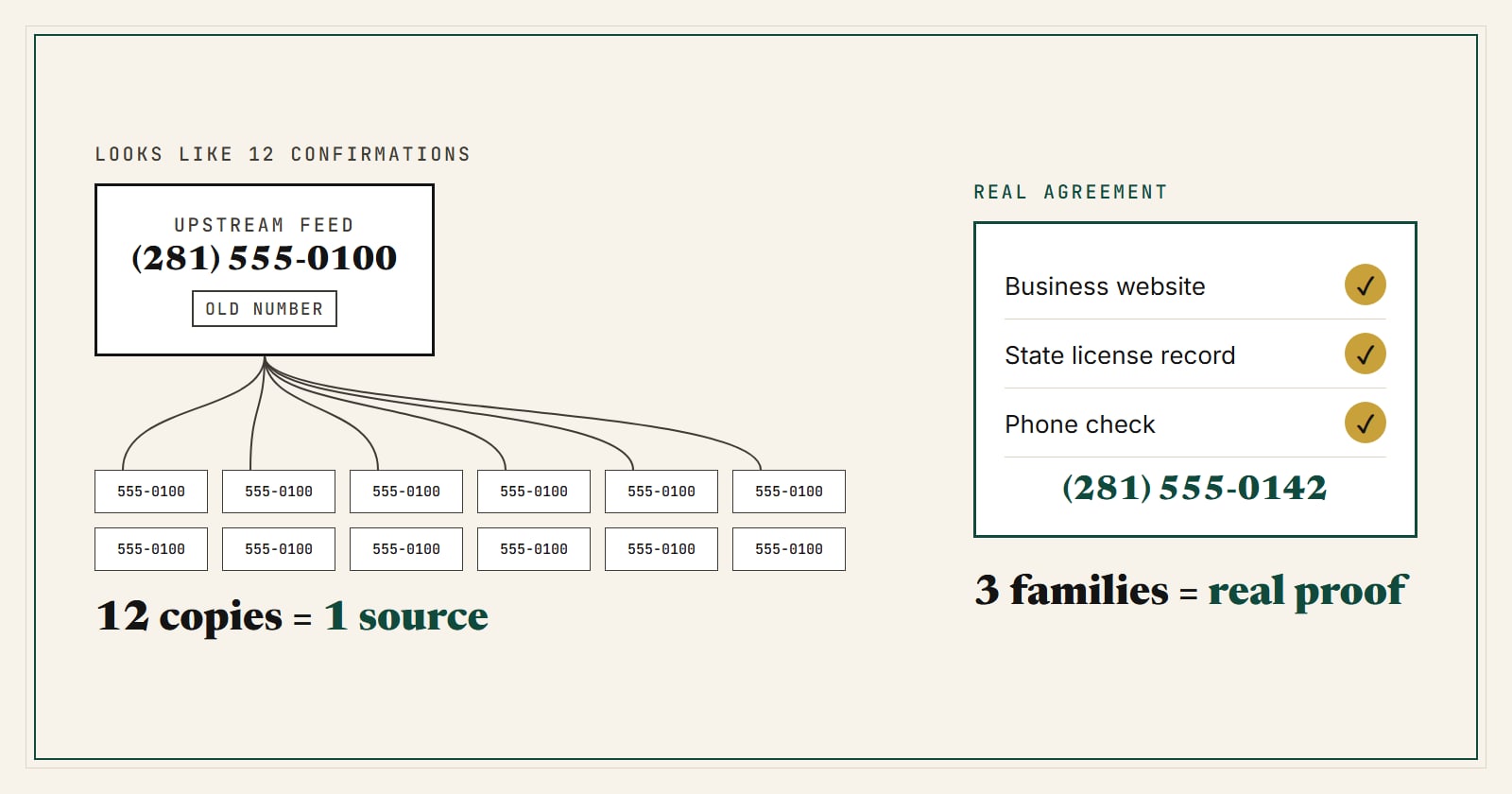
You changed your phone number a year ago. You updated your website and your Google Business Profile. Yet your old number is still on a dozen directories you have never heard of, and AI assistants keep repeating it. That is not bad luck. It is how business listings move around the internet.
One source, copied many times
A large share of small directory sites do not collect their own data. They buy or license it from a few upstream providers, often called data aggregators or listing networks, and republish it. When the upstream record is wrong, every site fed by it is wrong in the same way, at the same time.
To a person, twelve sites agreeing looks like proof. To a careless system, it looks like twelve confirmations. In reality it is one source, copied twelve times.
Why this matters more now that AI is answering
AI assistants and search systems try to decide which value is right by looking for agreement. If they count raw agreement, a stale value copied across many sites beats the correct value on your own website. This is part of why AI repeats old information even after you have fixed the places you know about.
Source families: the idea that fixes this
A better way to judge agreement is to group sources by where their data actually comes from. At Prompt Reach we call these source families:
- Business-controlled: your website, your social profiles, your own listing account.
- Platform-controlled: Google Business Profile, Apple Business Connect, Bing Places. Partly edited by you, partly by the public.
- Syndicated: directories fed by an upstream data provider. Many sites, often one source.
- Official: state licensing boards, Secretary of State business filings, permit records.
- Direct: someone actually calling the business, or a check against the business's own domain.
Agreement only counts when it comes from different families. Your website and a state license record agreeing is strong evidence. Ten syndicated directories agreeing is closer to one piece of evidence.
How to tell copies from real confirmations
The giveaway is shared mistakes. If several sites have the same unusual typo, the same odd formatting of your suite number, or the same phone number you dropped in 2023, they almost certainly copied from one place. Correct values are shared by honest sources too, so they prove less. Shared errors prove copying.
What to do about it
- Fix your own sources first. Website, Google Business Profile, Bing Places, Apple Business Connect. These are the strongest families and the ones you control.
- Find the upstream. Search for the exact wrong value in quotes, such as your old phone number. The sites that show it with the same quirks are probably one feed. Fixing or claiming the larger ones often clears many copies over time.
- Add an official anchor. If your trade is licensed, make sure your license record shows your current business name and address. Official records are a separate family and carry real weight.
- Publish a verified record. A Prompt Reach listing is tied to your own domain once you verify it, so it counts as the business speaking, not another copy.
How Prompt Reach treats copied data
We are building our verification around this idea: the first independent family to confirm a fact gives it full weight, a second independent family adds a little more, and extra copies from the same family add nothing. A competitor that counts raw agreement might report a stale number as "confirmed by 12 sources." We report it as one source, and we flag it when your own website disagrees.
FAQ
Do I need to fix every directory my business is on?
No. Start with your own website and the major platforms, then the directories that rank for your business name. Fixing an upstream source can correct many copies at once.
Why did my old information come back after I fixed it?
An upstream feed probably still has the old value and pushed it back out. Find and correct the upstream source, or the copies will keep returning.