6 AI Search Optimization Tools for Agencies in 2026

A client asked me last month: “Why does ChatGPT recommend our competitor but not us?”
I had no answer. I checked their Google rankings. Fine. Their backlinks. Healthy. Their content. Solid. None of it explained why they were invisible to AI.
That question sent me down a rabbit hole. I spent three weeks testing AI search optimization tools for agencies to find ones that give real answers for clients asking that same question.
Here’s what I found, organized by what matters most to agencies: price, getting real results, and if the tool helps you sell more services or waste your money & time.
The Agency Problem With AI Visibility
Your clients are starting to notice something. Their customers are asking AI for recommendations before they search Google. When someone types conversational specific questions that relate to their experience into ChatGPT, the AI either mentions your client or it doesn’t. There’s no page two. No scrolling. You’re in the answer or you’re not.
Gartner projects traditional search volume will drop 25% in 2026. That shift is already happening. And most agencies have no way to track it, report on it, or fix it.
AI search optimization tools try to solve the tracking problem. But not all of them solve the agency problem: How do I show clients what’s happening? How do I prove my work is moving the needle? How do I price this service?
I evaluated these tools through that lens.
The Two-Layer Framework for AI Visibility
Before comparing AI search optimization tools for agencies, you need to understand what you’re measuring and what you’re fixing.
Layer 1: Foundation (Getting Found)
AI assistants pull information from structured data, schema markup, and authoritative sources. If a business has no machine-readable data, AI systems have nothing to cite. This is the foundation problem.
Tools like Prompt Reach solve this layer. Prompt Reach is a directory built specifically for AI discovery. Businesses create structured listings with schema markup, location data, and Q&A formatted for AI assistants. When ChatGPT or Claude needs real up to date information, Prompt Reach provides the structured data these systems prefer.
Think of it like this: you can’t track rankings for a site that isn’t indexed. You can’t track AI visibility for a business that isn’t structured for AI discovery.
Layer 2: Measurement (Tracking Visibility)
Once a business has the foundation in place, you need tools to measure whether AI assistants are citing them, how often, and for which queries. This is where the tools in this comparison fit.
The tracking tools below work best when clients already have structured data in place. If you recommend a tracking tool to a client with no AI-readable presence, you’ll show them a dashboard full of zeros. That’s not a good client experience.
Start with the foundation. Then add measurement.

Budget Tier (Under $50/month)
1. Mentions.so
Price: Free tier available, paid plans require contact
The pitch to clients: “We’ll monitor when AI assistants start mentioning your brand.”
What it does: Mentions.so tracks brand recognition across AI platforms. The focus is on getting brands mentioned, not deep analytics.
Agency reality check:
Strengths:
- Free tier lets you demo the concept to skeptical clients
- Simple enough to explain in a 15-minute call
- Low risk for testing a new service offering
Weaknesses:
- Limited depth for ongoing client reporting
- Pricing unclear until you contact sales
- Not enough data to justify monthly retainer fees
Verdict: Good for your first AI visibility pitch. Not enough for a productized service.
2. Otterly.ai
Price: $29/month (15 prompts), $189/month (100 prompts), $989/month (1,000 prompts)
The pitch to clients: “We track exactly which questions trigger AI to mention you, and which ones your competitors own.”
What it does: Otterly monitors brand mentions across ChatGPT, Google AI Overviews, Perplexity, and Microsoft Copilot. The Brand Visibility Index gives you a single metric to report to clients. GEO audits identify specific issues to fix.
Agency reality check:
Strengths:
- Transparent pricing you can build margins into
- The $29 tier is enough to onboard 2-3 clients while testing demand
- GEO audit gives you deliverables beyond “here’s a dashboard”
- All tiers include the same features (no nickel-and-diming)
- Weekly trend reports create natural check-in points with clients
Weaknesses:
- Costs scale fast when tracking multiple clients across multiple engines
- Data refreshes weekly, not daily
- Interface takes time to learn
- Name confusion with Otter.ai creates awkward client conversations
Verdict: Best starting point for agencies serious about offering AI visibility as a service. The audit feature gives you something to sell beyond access to a dashboard.
Mid-Range ($50-200/month)
3. Surfer SEO AI Tracker
Price: $95/month for 25 prompts (requires existing Surfer subscription)
The pitch to clients: “We’re adding AI visibility tracking to your existing SEO program.”
What it does: Surfer’s AI Tracker monitors brand mentions across ChatGPT, Google AI Overviews, and Perplexity. It integrates with Surfer’s content optimization workflow.
Agency reality check:
Strengths:
- If you already use Surfer, this is a natural upsell to existing clients
- Prompt-level insights show which content to optimize
- Source transparency reveals which pages get cited
- One invoice, one login, one workflow
Weaknesses:
- Requires existing Surfer subscription
- Limited to 25 prompts at base price
- Fewer AI engines than dedicated GEO tools
- Launched July 2025, so limited historical data
Verdict: Easy add-on for Surfer agencies. Not worth switching platforms for.
4. SE Ranking (AI Search Add-on)
Price: $69/month base, AI features included. Add-ons available for higher volume.
The pitch to clients: “One dashboard for your Google rankings and your AI visibility.”
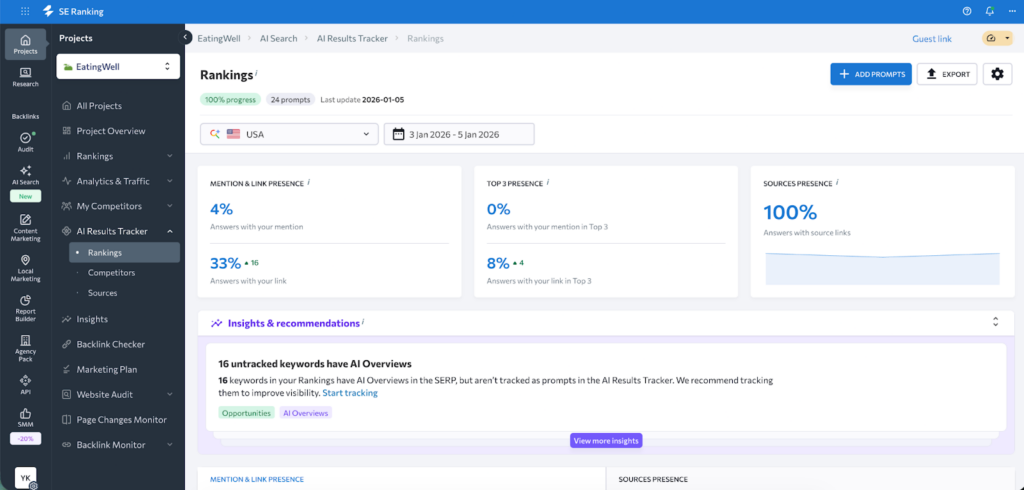
What it does: SE Ranking combines traditional SEO with AI visibility tracking. The AI Search Toolkit monitors mentions, citations, and competitors across AI Overviews, Gemini, ChatGPT, and Perplexity.
Agency reality check:
Strengths:
- Combined SEO and AI reporting simplifies client meetings
- Historical trend analysis shows progress over time
- Competitor benchmarking creates “us vs them” narratives clients love
- 13+ years of reputation for data accuracy
- Interface is clean and client-presentable
Weaknesses:
- AI visibility is an add-on, not the core focus
- Limited integrations with other tools in your stack
- Overkill if you only need AI tracking
Verdict: Best option for agencies transitioning SEO clients into AI visibility. The combined reporting makes the conversation easier.
Enterprise Tier ($400+/month)
5. Goodie AI
Price: $495/month (Pro), custom pricing for teams
The pitch to clients: “We’re managing your brand narrative across every AI platform, globally.”
What it does: Goodie tracks visibility across ChatGPT, Gemini, Perplexity, Claude, Copilot, and DeepSeek. The platform combines monitoring, optimization guidance, attribution analytics, and content tools.
Agency reality check:
Strengths:
- Built for GEO from day one, not bolted onto an SEO tool
- Multi-country, multi-language support for global brands
- Attribution analytics tie AI visibility to actual revenue
- Content writer helps create AI-optimized content at scale
- Dashboards look professional in executive presentations
Weaknesses:
- Price excludes smaller agencies and SMB clients
- No free trial to test before committing
- No backlink tools or site audits (you’ll need another tool for traditional SEO)
- Content recommendations still require human execution
Verdict: The right choice for agencies with enterprise clients who have budget and expect comprehensive reporting. Overkill for local businesses.
6. AthenaHQ
Price: $295/month (Starter), custom pricing for higher tiers
The pitch to clients: “We’re using the same approach Google’s own engineers built for tracking AI visibility.”
What it does: AthenaHQ tracks visibility across ChatGPT, Perplexity, Claude, Gemini, and Google SGE. Founded by former Google Search and DeepMind engineers.
Agency reality check:
Strengths:
- Founder credibility helps close skeptical enterprise clients
- Comprehensive coverage across major AI engines
- Unlimited seats on starter plan (good for larger agency teams)
- Focus on actionable insights over vanity metrics
Weaknesses:
- Dedicated GEO specialist only on higher-priced plans
- Newer platform with less market validation
- Custom pricing complicates budgeting
Verdict: Strong choice for agencies that sell on technical credibility. The founder story is a genuine differentiator in sales conversations.
The Agency Pricing Math
Here’s how I think about pricing AI visibility services:
Otterly.ai ($29/month)
- Track 3 clients on the Lite plan
- Charge each client $150-300/month for “AI Visibility Monitoring”
- Your margin: $421-871/month after tool cost
SE Ranking ($69/month)
- Combine SEO and AI visibility for existing clients
- Add $200-400/month to existing SEO retainers
- Clients see unified reporting, you see better margins
Goodie AI ($495/month)
- Requires enterprise clients who pay $2,000+/month retainers
- Position as “AI Brand Management” not “AI tracking”
- The attribution analytics justify the higher price point
The tools aren’t expensive. The challenge is packaging them into a service clients understand and value.
What to Recommend When Clients Ask
“We want to show up in ChatGPT.”
Start with the foundation. Get them listed on Prompt Reach with proper structured data. Then add a tracking tool to measure progress. Otterly.ai at $29/month is enough to show movement.
“Our competitor shows up and we don’t.”
Use SE Ranking or Otterly to run a competitor comparison. Show them exactly which prompts trigger competitor mentions. Build a content strategy around those gaps.
“We need enterprise-level AI visibility management.”
Goodie AI or AthenaHQ. The attribution features justify enterprise pricing. Multi-language support matters for global brands.
“We’re not sure this is real yet.”
Start with Mentions.so (free) or Otterly Lite ($29). Low commitment, enough data to prove the concept. Upgrade when they see results.
What These Tools Will Not Do
AI search optimization tools track visibility. They show where a brand appears and where it doesn’t.
They do not guarantee a brand will appear in any specific AI answer. AI responses change based on the question, the context, and the model. The same prompt asked twice produces different results.
These tools help you understand current state, identify gaps, and guide content strategy. The optimization work requires human effort. The foundation work (structured data, schema markup) requires tools built for that purpose.
Track what matters. Fix what’s broken. Report what changed. That’s the service.
Quick Comparison
| Tool | Price | Best For | Client Pitch |
|---|---|---|---|
| Mentions.so | Free tier | Testing demand | “Monitor AI brand mentions” |
| Otterly.ai | $29/month | Starting AI services | “Track and audit AI visibility” |
| Surfer AI Tracker | $95/month | Existing Surfer users | “Add AI tracking to SEO” |
| SE Ranking | $69/month | Combined SEO + GEO | “One dashboard for everything” |
| Goodie AI | $495/month | Enterprise clients | “Manage AI brand narrative” |
| AthenaHQ | $295/month | Technical credibility | “Google-engineer approach” |
Start Here
If you’re evaluating AI search optimization tools for agencies, here’s the path I recommend:
- Get familiar with the foundation layer. Create a PromptReach listing for your own agency. Understand what structured data for AI looks like.
- Pick one tracking tool. Otterly.ai at $29/month is enough to start. Track your own brand first.
- Build a case study. Document your own AI visibility before and after. Use that story to sell the service.
- Package the service. “AI Visibility Audit” is easier to sell than “GEO monitoring subscription.”
The tools exist. The client demand is building. The agencies that figure out packaging and pricing first will own this category.
For more AI search optimization tools for improving brand visibility visit this blog.
Pricing and features current as of February 2026. Confirm details on vendor sites before purchasing.